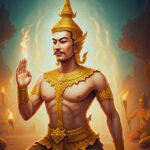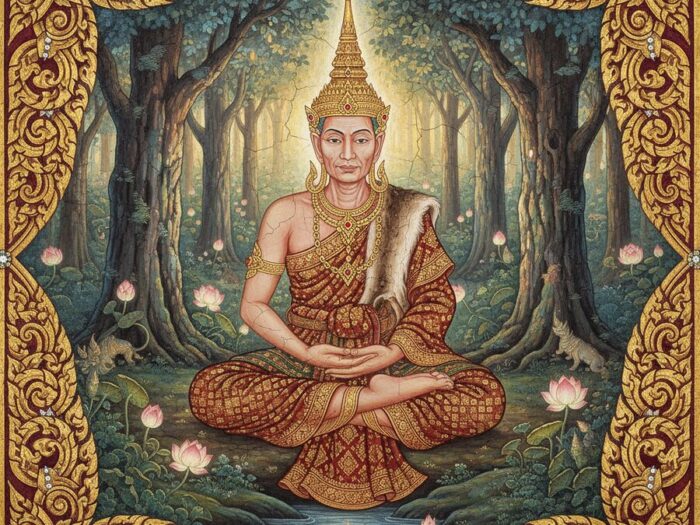
A traditional authentic Thai Buddhist temple mural wall painting of a powerful Ruesi Lersi hermit sage wearing a golden Chada crown, sitting in deep meditation in a mystical forest, framed by intricate golden Lai Thai Kranok patterned borders

The Lersi (ฤาษี), also spelled Ruesi, hold a profound and foundational place within Thai folklore, animism, and occult practices. These revered hermit sages are regarded as enlightened beings who have attained mastery over various esoteric arts, including meditation, herbal medicine, magic, and alchemy. The term “Lersi” originates from the Sanskrit word “Rishi,” which translates to a seer, sage, or inspired poet of the Vedic traditions.

Origins and the Vedic Connection

To understand the Ruesi in the context of Thai Buddhism, one must look back to the spiritual migrations from the Indian subcontinent. In Thai mythology, the Lersi are often believed to predate the historical Buddha, Siddhartha Gautama, or to have been his most advanced contemporaries and disciples. According to legendary chronicles, the Buddha himself was taught the highest forms of meditative absorption (Jhana) by hermit sages before finding the Middle Way.
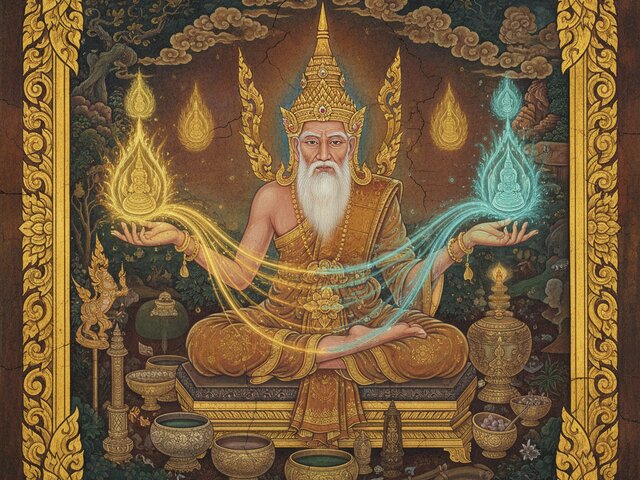
A traditional Thai Buddhist temple mural of a Ruesi Lersi hermit sage wearing a golden Chada crown, magically creating sacred amulets with glowing energy, framed by Lai Thai Kranok borders
Lersi sages are revered as the original masters of Wicha (magic) and the creators of powerful metaphysical amulets.

Following the Buddha’s enlightenment, it is said that he taught his most advanced disciples the deepest secrets of spiritual practice. These disciples retreated to the dense forests and high mountains to lead lives of extreme asceticism. By detaching completely from worldly desires, they cultivated supernatural powers (Abhinna), enabling them to perform miraculous feats and communicate with celestial beings.

The Anatomy of a Lersi

In authentic Thai Buddhist art and temple murals, the Lersi are highly stylized. They are almost universally depicted as ascetic hermits with long flowing white beards, unkempt hair, and wearing the distinctive tiger-skin loincloths—a symbol of their mastery over the wild and their ability to tame the inner “beast” of human defilement.

Crucially, higher-tier Lersi are portrayed wearing the Chada (ชฎา), the tall, ornate, spire-like golden crown. This headpiece represents their elevated spiritual status and connection to the heavenly realms. They are frequently depicted holding symbolic ritual objects: a wooden staff to ward off evil spirits, a rosary (Mala) for reciting Kathas (incantations), a begging bowl, or an alchemical mortar for grinding sacred medicinal herbs.

The 108 Ruesi of Legend

Thai esoteric tradition speaks of the “108 Ruesi” (108 being a sacred, infinite number in Dharmic traditions). This collective represents a vast pantheon of masters, each embodying a specific spectrum of esoteric knowledge. Among the most prominent are:
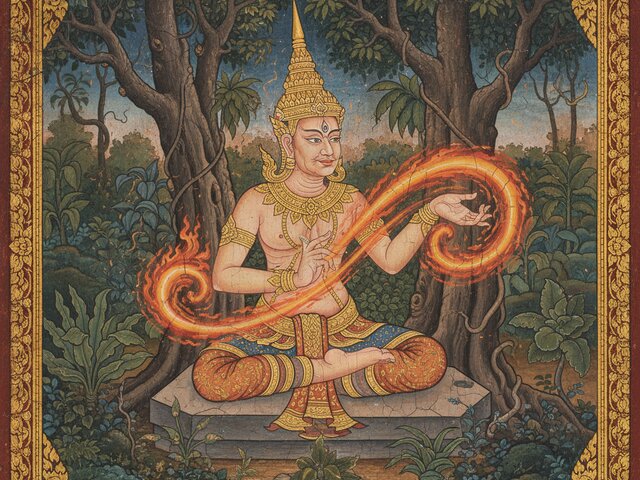
A traditional Thai Buddhist temple mural of Ruesi Tafai with a third eye and a golden Chada crown, manipulating fire magic, framed by Lai Thai Kranok borders
Ruesi Tafai (Gabin Muni), the fiery sage with a third eye, known for his destructive and purifying fire magic.

Ruesi Narot: Often considered the primary teacher and grandfather of the magical arts, representing foundational wisdom and musical knowledge.

Ruesi Tafai (Gabin Muni): The famous “Fire-Eyed Hermit.” He is depicted with a third eye on his forehead. It is said that if he opens this eye, it unleashes a purifying fire capable of destroying all enemies and black magic. He is heavily revered for protection and combat magic.

Ruesi Petchalugan: The patron sage of engineering, mechanics, and sacred architecture.

The Origins of Sak Yant

One of the most vital contributions of the Lersi to modern Thai culture is their role as the originators of Sak Yant—the tradition of sacred geometric tattooing. Over two millennia ago, blending ancient Tai tribal animism with Khmer Empire sorcery, the Ruesi developed these intricate designs.
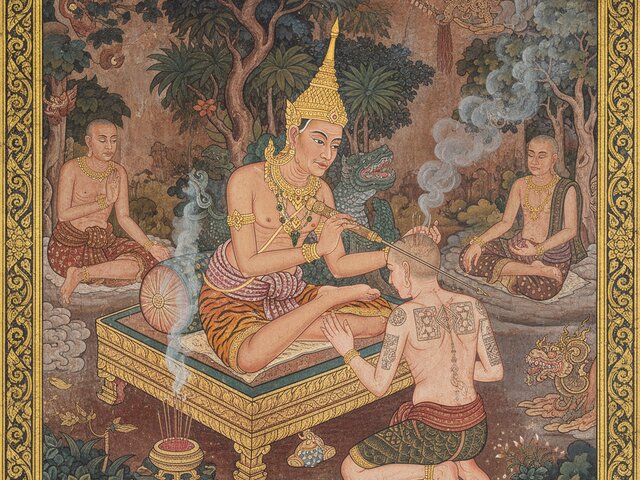
A traditional Thai Buddhist temple mural of a Ruesi Lersi master wearing a golden Chada crown performing a Sak Yant tattoo ceremony, framed by Lai Thai Kranok borders
The Lersi are the original lineage holders of the Sak Yant tradition, passing down sacred geometry through generations.

Using a traditional metal rod (Khem Sak), the master drives magical geometry, animal representations (like the Tiger or Hanuman), and ancient Khom script into the skin. These Yantras are accompanied by specific Pali incantations designed to bestow blessings of invulnerability (Kong Grapan), authority (Maha Amnaj), or prosperity. To receive a Sak Yant is to directly connect with the lineage of the Ruesi.
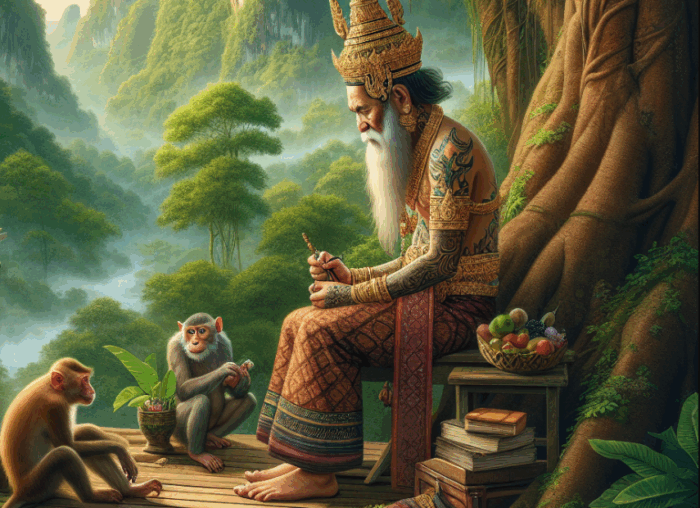
Naradha Rishi (Ruesi Narot)

Contemporary Reverence and the Wai Kroo

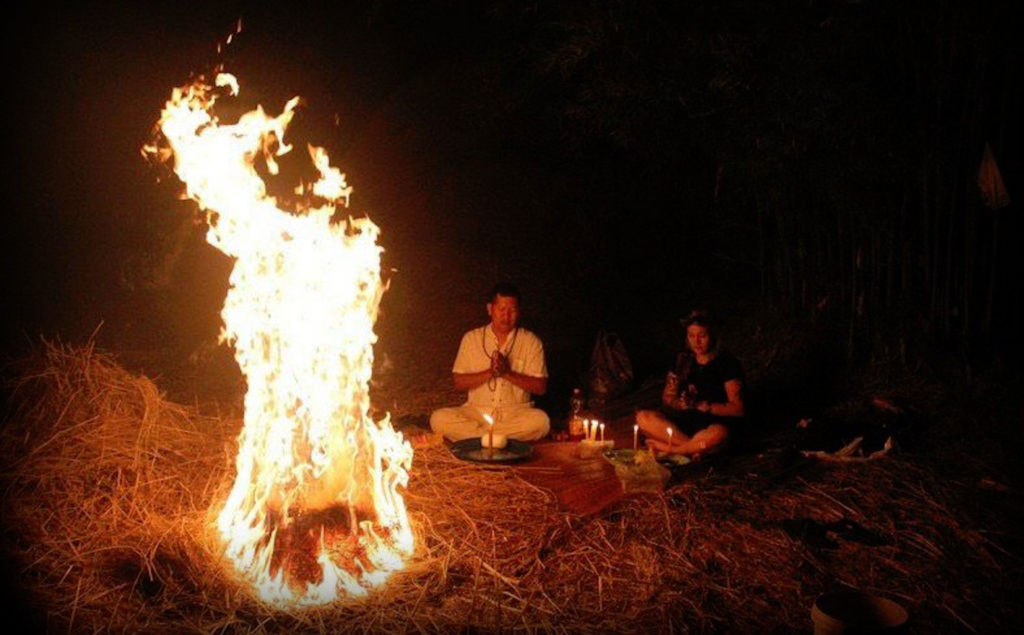
In modern Thai society, the reverence for the Lersi remains a powerful force. They are the patron deities of musicians, actors, astrologers, tattoo masters, and amulet makers. The most spectacular display of this devotion is the annual Wai Kroo (Master Day) ceremony.
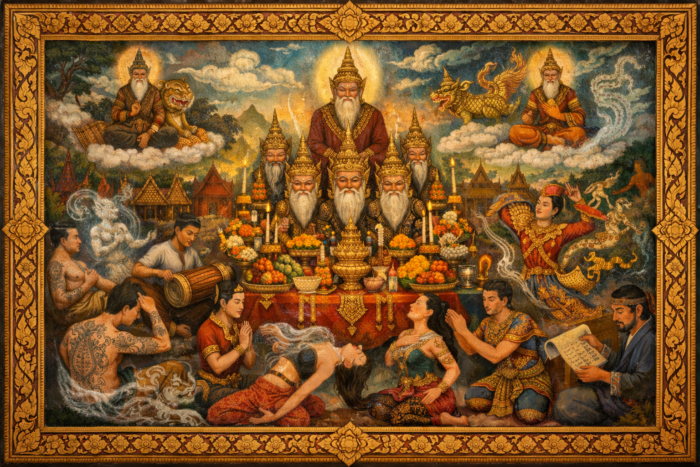
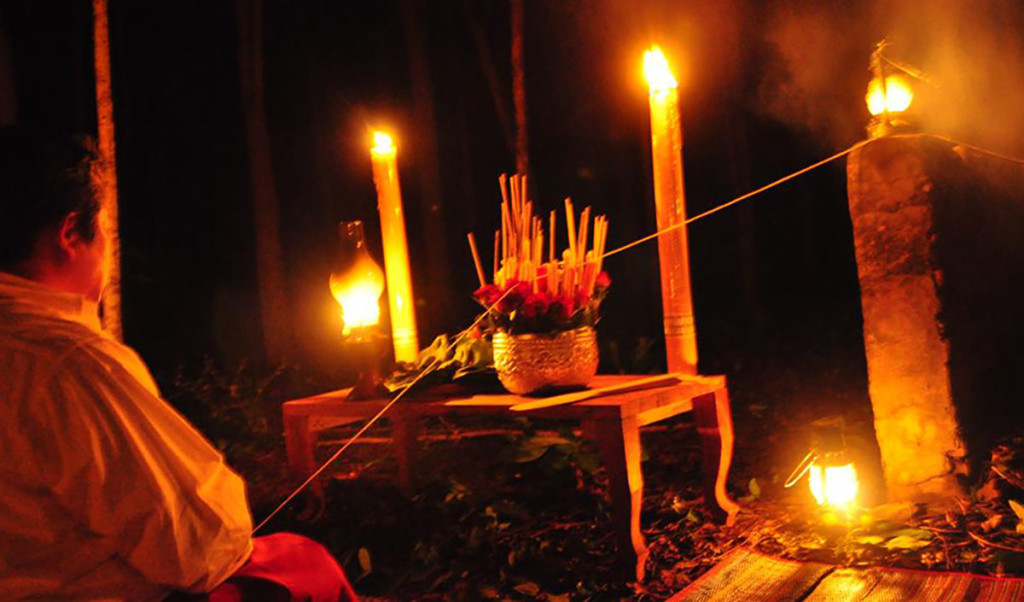
Wai Kroo Ruesi 108

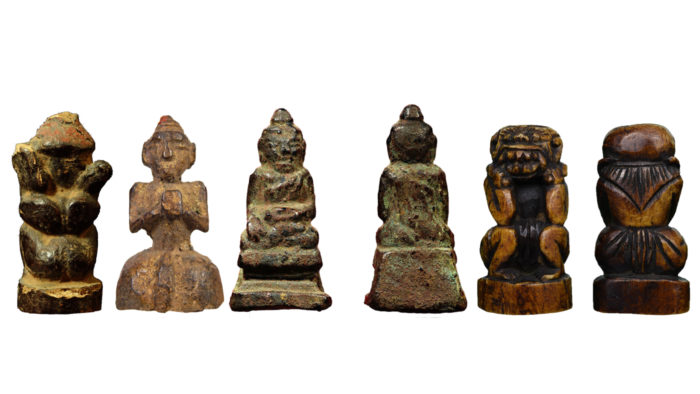
During Wai Kroo, devotees gather to pay respects to the lineage of masters. Participants often enter deep trance states (Khong Kuen), manifesting the spirits of the Ruesi or the mythical animals tattooed upon their bodies. Offerings of betel nut, tobacco, fruits, and incense are given to intricately crafted Ruesi masks (Hua Khon) placed upon the central altar.
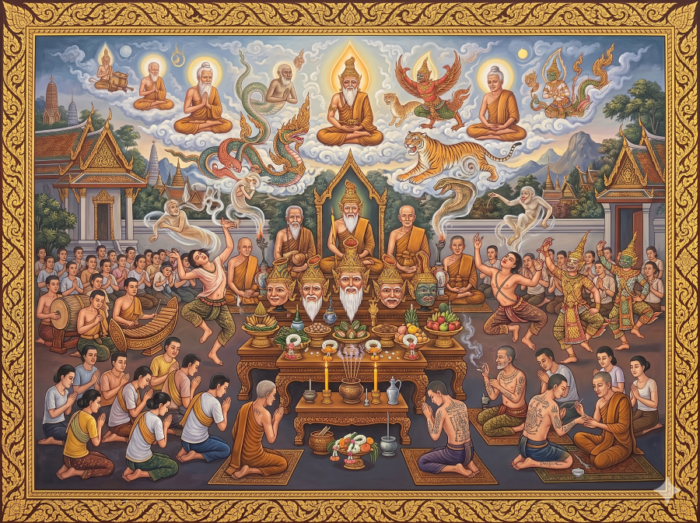
The Lersi occupy a unique and indispensable position bridging Thai Buddhism and the older, raw magic of the land. As enlightened beings and masters of esoteric knowledge, they embody the pursuit of spiritual excellence, magical prowess, and transcendental wisdom. Through devotion to the Lersi, practitioners seek not just protection, but a guiding hand on the journey toward ultimate liberation.

Written by Ajarn Spencer Littlewood
buddhamagic.net
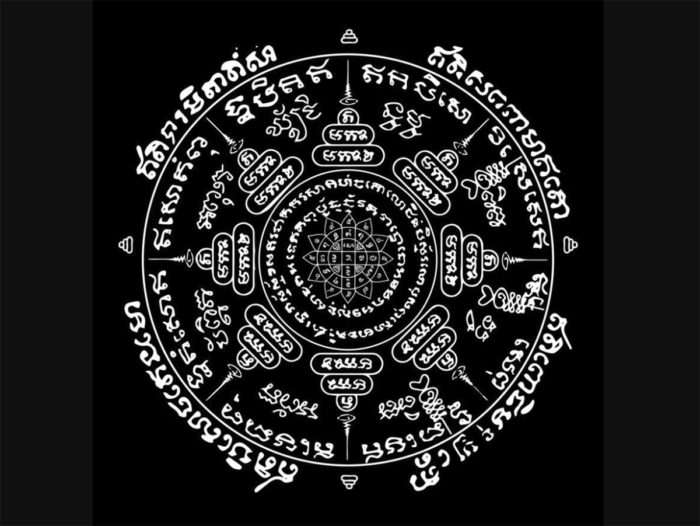
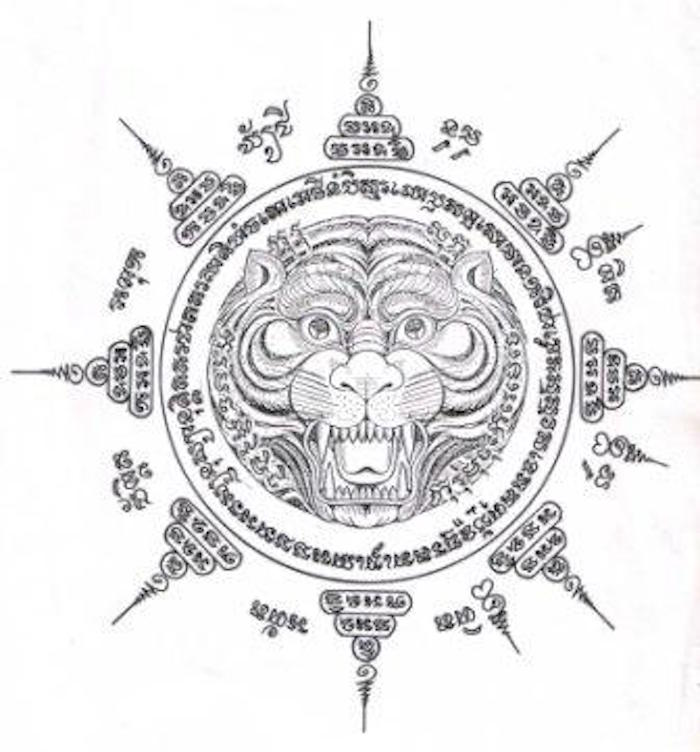
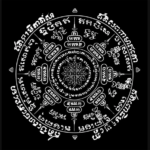
Yant Paed Tidt 8 directional Yantra (Version ). This Yant is representative of the 8 directions of the Universe and has a kata to protect you in each direction you may travel in. Anyone interested in learning to make Yant magic and Kata spells (plus wishing to receive blessings) should practise this kata as often as possible . I RA CHA KA THA RA SAA (chant when travelling to the east – also chant and blow into your food for protection against illness/danger) THI HANG JA THOE ROE THI NANG (chant when travelling Southeast) BI SAM RA LOE BU SATH PUT (chant when travelling south ) SOE MAA NA GA RI TAA TOE (chant when travelling Southwest) PA SAM SAM WI SA TAE PA (chant when travelling West) KA PUT BAN TUU TAM WA KA (chant when travelling Northwest) WAA TOE NOE A MA MA WAA (chant when travelling North) A WICH SU NUCH SAA NU THI (chant when travelling Northeast) Heart of Ithibisoe Mantra (Kata) is; A SANG WI SU LOE BU SA PU PA here is the analysis of how it is related to Idtibisoe; A – means Arahang Sam – means Sammaa Samputtoe Wich – means Wichaa Jarana Sambanoe Su – means Sukathoe Loe – means Loekawituu Anutharoe Bu – means Burisa Tamma Saarati Sa – means Sattaa Taewa Manussanang Pu – means Puttoe Pa – means Pakawaathi

The Use and Meaning of the Eight Directions in Thai Buddhism and Occult Beliefs

In the Royal Institute Dictionary, dated 2542 B.E., the term “ทิศ” or “ทิศา” is defined as meaning “direction” or “side” (referring to the cardinal points such as north, south, east, west, etc.). In poetic language, “ทิศาดร” can be interpreted as “directions.”

Below; Yant Paed Tidt Sak Yant Thai Temple Tattoo Design

Yant Paed Tidt 8 directional Yantra tattoo design

Yant Paed Tidt 8 directional Yantra tattoo design (tiger face version)

    • Descriptions of the eight directions according to the Royal Institute Dictionary are as follows:
      • “อุดร” (Udorn) – The northern direction, also known as “ทิศอุดร” (Northern direction; left side).
      • “อาคเนย์” (Ākaneuy) – The southeast direction, alternatively referred to as “ทิศอาคเนย์” (Southeast direction; right side).
      • “ทักษิณ” (Taksin) – The southern direction, also denoted as “ทิศทักษิณ” (Southern direction; right side).
      • “บูรพา” (Bura-pa) – The southwest direction, also known as “ทิศบูรพา” (Southwest direction; left side).
      • In astrology, each of these eight directions is associated with a specific celestial body and represented by a numerical value as follows:
        • Sun, associated with the East-Northeast direction, represented by the number 1.
        • Moon, linked to the Southeast direction, represented by the number 2.
        • Mars, connected to the East-Southeast direction, represented by the number 3.
        • Mercury, aligned with the South-Southeast direction, represented by the number 4.
        • Jupiter, associated with the West-Southwest direction, represented by the number 7.
        • Venus, linked to the North-Northwest direction, represented by the number 5.
        • Saturn, connected to the Northwest direction, represented by the number 8.
        • Friday, associated with the East-Northwest direction, represented by the number 6.

These eight directions are also used in astrology, and have specific celestial bodies associated with them. Each direction is represented by a number.

Astrological Eight Directions and Their Associations:

  1. Direction: East-Northeast (ทิศอีสาน)
    • Associated Celestial Body: Sun
    • Represented Number: 1
  2. Direction: Southeast (ทิศอาคเนย์)
    • Associated Celestial Body: Moon
    • Represented Number: 2
  3. Direction: East-Southeast (ทิศตะวันออกเฉียงใต้)
    • Associated Celestial Body: Mars
    • Represented Number: 3
  4. Direction: South-Southeast (ทิศตะวันตกเฉียงใต้)
    • Associated Celestial Body: Mercury
    • Represented Number: 4
  5. Direction: West-Southwest (ทิศตะวันตกเฉียงเหนือ)
    • Associated Celestial Body: Jupiter
    • Represented Number: 7
  6. Direction: North-Northwest (ทิศอุดร)
    • Associated Celestial Body: Venus
    • Represented Number: 5
  7. Direction: Northwest (ทิศตะวันตก)
    • Associated Celestial Body: Saturn
    • Represented Number: 8
  8. Direction: East-Northwest (ทิศอุดร)
    • Associated Celestial Body: Friday
    • Represented Number: 6

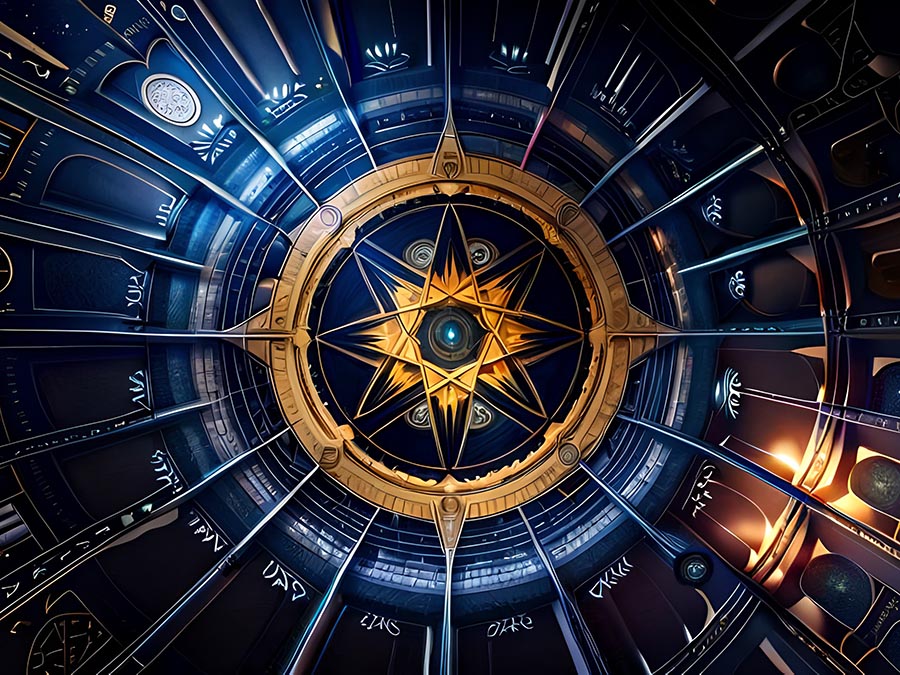
8 directional sacred geometry diagram - Design made using Natural Language Prompts on Bluewillow AI on Discord

Explanation:

In astrology, the concept of the eight directions is tied to the belief that celestial bodies have influence and power over various aspects of life and destiny. Each direction is associated with a specific celestial body, and these associations are used in astrological calculations and predictions.

Sun (Number 1): The Sun is associated with the East-Northeast direction. It represents qualities related to vitality, energy, and leadership. People born under this direction may be seen as leaders or have strong leadership qualities.

Moon (Number 2): The Moon is linked to the Southeast direction. It represents emotions, intuition, and sensitivity. Those influenced by the Moon may have strong emotional connections and intuitive abilities.

Mars (Number 3): Mars is connected to the East-Southeast direction. It signifies courage, assertiveness, and action. Individuals influenced by Mars may be assertive and take initiative.

Mercury (Number 4): Mercury is associated with the South-Southeast direction. It represents communication, intellect, and adaptability. People influenced by Mercury may excel in communication and intellectual pursuits.

Jupiter (Number 7): Jupiter is linked to the West-Southwest direction. It symbolizes expansion, abundance, and growth. Those influenced by Jupiter may experience opportunities for growth and prosperity.

Venus (Number 5): Venus is aligned with the North-Northwest direction. It represents love, beauty, and sensuality. People influenced by Venus may have a strong appreciation for aesthetics and love.

Saturn (Number 8): Saturn is associated with the Northwest direction. It symbolizes discipline, responsibility, and challenges. Individuals influenced by Saturn may face obstacles but can achieve success through discipline.

Friday (Number 6): Friday is connected to the East-Northwest direction. It signifies balance, harmony, and relationships. People born on this day may have a natural inclination towards maintaining balance in their lives and forming strong relationships.

These associations provide astrologers with insights into an individual’s character, destiny, and life path based on the direction corresponding to their birth.